Reading
Intent
At Littlebourne CE Primary School, our curriculum is thoughtfully designed to nurture caring, confident and curious learners with a genuine passion for learning and achievement. We believe that reading is the foundation of this passion, opening doors to knowledge, sparking curiosity about the wider world, and supporting each child in building a happy and successful future.
Our curriculum is planned to ensure that every child leaves Littlebourne CE Primary School equipped with strong reading skills, regardless of their starting point. In Key Stage 1, children learn to read; in Key Stage 2, they read to learn. As highlighted in the Rose Review, “learning to read progresses to reading, effortlessly, to learn.” Without secure reading skills, children cannot fully access the joy and breadth of learning. For this reason, fostering both the ability to read and a lasting love of reading remains at the heart of everything we do.
Implementation
Children’s reading development is supported daily through access to a wide range of high‑quality texts that are carefully matched to their reading level, with appropriate challenge built in. They are given regular opportunities to read independently, to read with teachers, teaching assistants and volunteers, and to experience modelled reading during our daily read‑aloud sessions. Early phonics teaching lays the foundations for decoding, and guided reading sessions help children build strong comprehension skills. Across the curriculum, including science, computing and the wider foundation subjects, children encounter rich and engaging texts that broaden their knowledge and vocabulary.
We implement the teaching of reading through a broad range of purposeful reading experiences, including:
- Shared and guided reading in EYFS
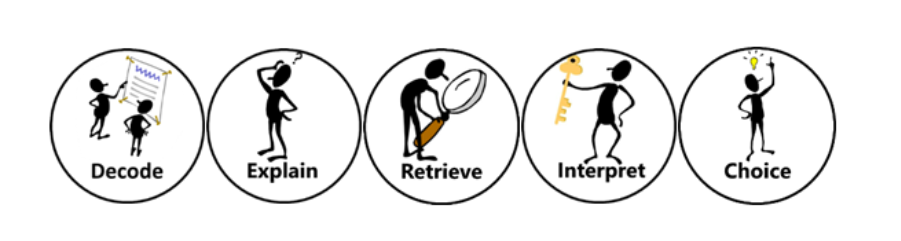
- Whole-class reading lessons from EYFS onwards, focused on vocabulary, comprehension and fluency, using DERICs to develop key reading skills
DERIC
Decode, Explain, Retrieve, Interpret and Choice (DERIC)
- Guided reading progressing to structured whole-class reading lessons from Year 1 upwards
- Daily, high-quality phonics teaching in EYFS and KS1, with targeted phonics interventions in KS2 where needed
- Applying phonics knowledge in real-life and cross-curricular contexts
- Independent reading time
- Home–school reading to strengthen partnership with families
- Daily read aloud sessions, so children hear and enjoy high quality literature
- Reading within other subjects, including ICT texts used for research
- Dedicated “reading for pleasure” time
- Carefully chosen, high quality texts linked to subjects across the curriculum
- Opportunities to meet authors and take part in enrichment days and themed weeks
How is reading taught at Littlebourne CE Primary School?
Phonics
Phonics is taught daily in EYFS and Key Stage 1, both through discrete lessons and through continuous and enhanced provision. This ensures children build secure early reading skills in a structured and supportive way.
Whole-Class Reading
During whole-class reading sessions, children listen to stories and explore books together. These sessions are teacher led and provide opportunities for pupils to engage with texts, share ideas and respond to differentiated questions. Whole-class reading often takes place within English lessons but is also embedded across the wider curriculum. Many classes use shared texts as the foundation for their English learning.
Shared Reading
In English lessons, children work with a range of text types used as stimuli for writing. Teachers and pupils read these texts together, with the teacher modelling expert reading skills and highlighting key features, vocabulary and ideas.
Guided Reading
Guided Reading is delivered either as whole-class sessions or in smaller groups with a teacher or teaching assistant. These sessions focus on developing children’s independence as readers, thinkers and learners. Pupils read high quality fiction and non‑fiction texts that extend and challenge their understanding, helping them to deepen both their comprehension and their confidence.
Guided Reading sessions focus on these key skills for reading:
Reading for pleasure:
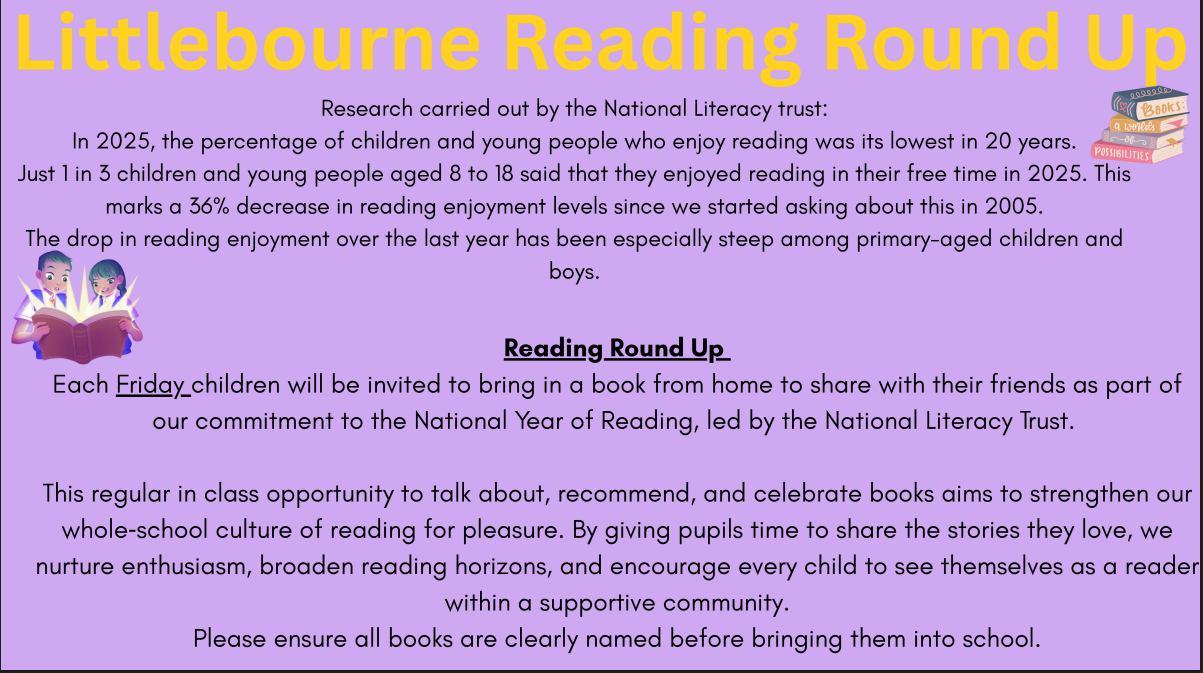
Reading for pleasure is at the heart of our approach. We provide children with rich opportunities to discover texts they enjoy, helping them develop positive reading habits that support both wellbeing and academic success. Every Friday children are encouraged to bring in books from home to participate in the Littlebourne Reading Round Up. Children bring books in to school that they are currently enjoying. They share the joy of reading with their friends and teachers, make recommendations and have no other task than to simply enjoy whatever they are reading.
Impact:
One of the most significant impacts of our reading provision extends far beyond statutory assessment outcomes. Our children develop a genuine enthusiasm for reading and a love of texts across a wide range of genres and formats. This passion supports their progress throughout their education and equips them with essential skills for their lifelong learning journey.
Through systematic phonics teaching, rich exposure to high quality vocabulary and explicit comprehension instruction, we aim for all children to become fluent, confident readers. We want them not only to access the full breadth of the curriculum, but also to enjoy stories and texts that inspire, engage and encourage reading for pleasure.
We measure impact in a range of ways: pupil voice, termly assessments, teachers’ ongoing assessment for learning, high quality work produced across the curriculum, classroom and corridor displays and home reading records. This information is regularly reviewed to identify children who may need additional support. A range of targeted interventions is then used to help ensure all children work towards achieving at least the expected standard in reading.
As they progress, children develop a strong understanding of different question types: Decode, Explain, Retrieve, Interpret and Choice (DERIC)—and learn to apply these skills across subjects. They also experience a wide variety of high quality texts, carefully chosen to link with and enhance their wider curriculum learning.
By working in partnership with families and fostering a rich reading culture, we aim to inspire every child to discover the joy and power of reading.