
Phonics
 Phonics
What is phonics?
Phonics is a way of teaching children to read and write by helping them understand how the sounds of spoken language link to the letters on the page.
In phonics, children learn:
The sounds (phonemes) that letters and groups of letters make
(for example: s, sh, ai, igh)
How to blend sounds together to read words
(e.g., c-a-t becomes cat)
How to segment words to spell them
(breaking ship into sh-i-p)
Phonics gives children the building blocks they need to become confident, fluent readers. Once they know the most common sounds and patterns, they can work out new or unfamiliar words on their own.
Intent
Phonics (Reading and Spelling)
At Littlebourne Church of England Primary School, we believe every child can become a confident reader and writer. We teach phonics using Little Wandle Letters and Sounds Revised, a systematic programme that helps children learn how letters and sounds work together.
Phonics teaching begins in Reception and follows a clear progression, allowing children to build their skills step by step. This helps them read and spell confidently as they move through the school. This also includes children understanding and recognising 'tricky words' where words like 'the' and 'you' that can’t be easily sounded out with early phonics knowledge and that often contain unusual spellings or sounds not yet taught are learnt.
We also show children how to use their phonics knowledge during shared reading and writing in all areas of learning. Language development is a key focus for us, as speaking and listening skills are essential for reading and writing success.
Comprehension
We believe reading is an important life skill. When children leave Littlebourne, they can read confidently, understand what they are reading, and enjoy books for pleasure. They are also equipped with strategies to tackle new or challenging vocabulary.
We want all children to see themselves as readers—for enjoyment and for learning.
To support this, we have a dedicated Reading Leader who oversees early reading across the school. They are highly trained in phonics and reading and ensure that all staff teach the Little Wandle programme with consistency and expertise.
Implement
Daily Phonics in Reception and Year 1
- Children have a daily phonics lesson (building from 10 minutes in Reception to 30 minutes).
- We follow Little Wandle Letters and Sounds Revised to ensure children make strong progress.
- Reception: Children learn Phase 2 and 3 sounds and begin Phase 4.
- Year 1: Children review earlier phases and learn Phase 5 sounds.
- Year 2: Children in Year 2 may need to revisit some of the phonics taught previously before moving onto spelling units where they explore spelling rules and patterns such as adding prefixes, suffixes and alternative ways of spelling.
Keep‑Up Support
- Any child who needs extra help has daily, small‑group 'Keep‑Up' sessions led by trained staff. Children in Year 2 or 3 who are not yet fluent continue daily phonics until gaps are filled. Children in Years 3–6 receive short phonics catch‑up sessions if needed.
Reading Practice Sessions
- Children read with an adult in small groups three times a week. Books are matched to each child’s phonics level. Each session focuses on one key skill:
- Decoding (sounding out)
- Prosody (expression)
- Comprehension (understanding)
- Extra blending practice is given to children who need it.
Reading at Home
- Children access their matched reading book at home with phonically decodable books matched to their ability and taught phonemes. A separate “reading for pleasure” book is also sent home to enjoy with family.
Consistency and High Expectations
- We follow the same routines, resources and lesson structures across the school.
- Reading Leaders and senior staff regularly check progress and identify children needing extra support.
Reading for Pleasure
We want every child to love reading.
- We read to children daily and choose a diverse range of high‑quality books.
- Every classroom has an inviting reading corner.
- Reception children freely access books throughout the day.
- Children and families share reading comments through Tapestry or reading records.
- As children get older, they record their own reading and favourite books.
- Classes visit the school library regularly and take part in book‑related events such as book fairs, workshops and national reading celebrations.
Impact
Assessment
We assess children regularly to make sure they are making good progress and to spot anyone who needs extra support as early as possible.
Ongoing Assessment
- Daily: Teachers check understanding in lessons and identify children who may need Keep‑Up sessions.
- Weekly: Review lessons help us spot any gaps and quickly secure key sounds and spellings.
- Every six weeks: We assess each child’s progress, identify gaps, and plan any extra support needed.
- Senior leaders also check this information to ensure all children are keeping up and to support staff where needed.
- Children new to the school complete a Little Wandle placement assessment so we can quickly identify any gaps in phonics knowledge.
Statutory Assessment
- Children in Year 1 take the national Phonics Screening Check in June.
- Children who do not reach the score required, has further support and resits the assessment in Year 2.
Assessment for Catch‑Up (Years 2–6)
- Teachers use ongoing assessment, the Little Wandle placement assessment and half‑termly checks.
Little Wandle Progression
|
Reception |
Year One |
Year Two |
|
Term 1 Begin Phase 2 Term 2 Phase 2 Reading practice begins Term 3 & 4 Phase 3 Term 5 & 6 Phase 4 |
Term 1 Recap Phase 3 & 4 Term 2,3,4 Phase 5 Term 5 Review Phase 5 Term 6 Phonics screen check No new GPCs or tricky words |
Term 1 Review Phase 5 GPS Term 2 Bridge to spelling Term 3-6 Little Wandle Spelling units |
How to support your child at home
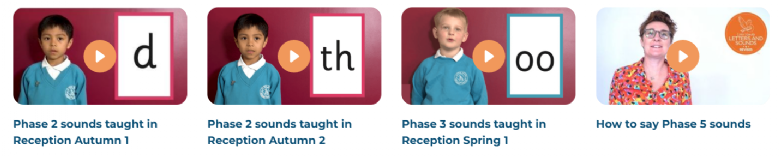
On the Little Wandle website, there is a page dedicated to supporting parents with phonics and reading at home. If you are unsure of how to pronounce the sounds, there are videos to show you. They can be found here: https://www.littlewandle.org.uk/resources/for-parents/
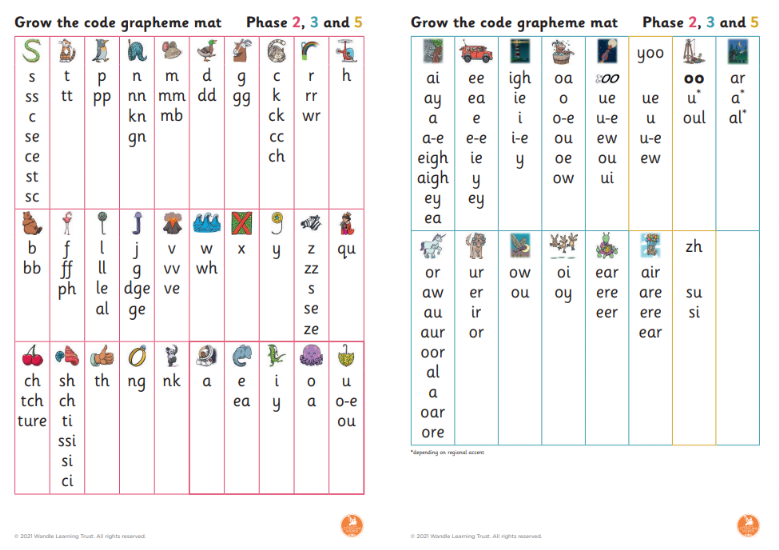
Also on the Little Wandle website, there are documents to support you with the order the phonemes taught with phrases to remember the sounds and how to write the graphemes.
Useful Websites